Now Available on the App Store
Plan trips, nail your pre-departure checks, track your van's maintenance, and explore every landscape Australia has to offer — all in one beautifully designed app.
Not a generic camping app tweaked for Australia. Built from the ground up for Australian caravanners.
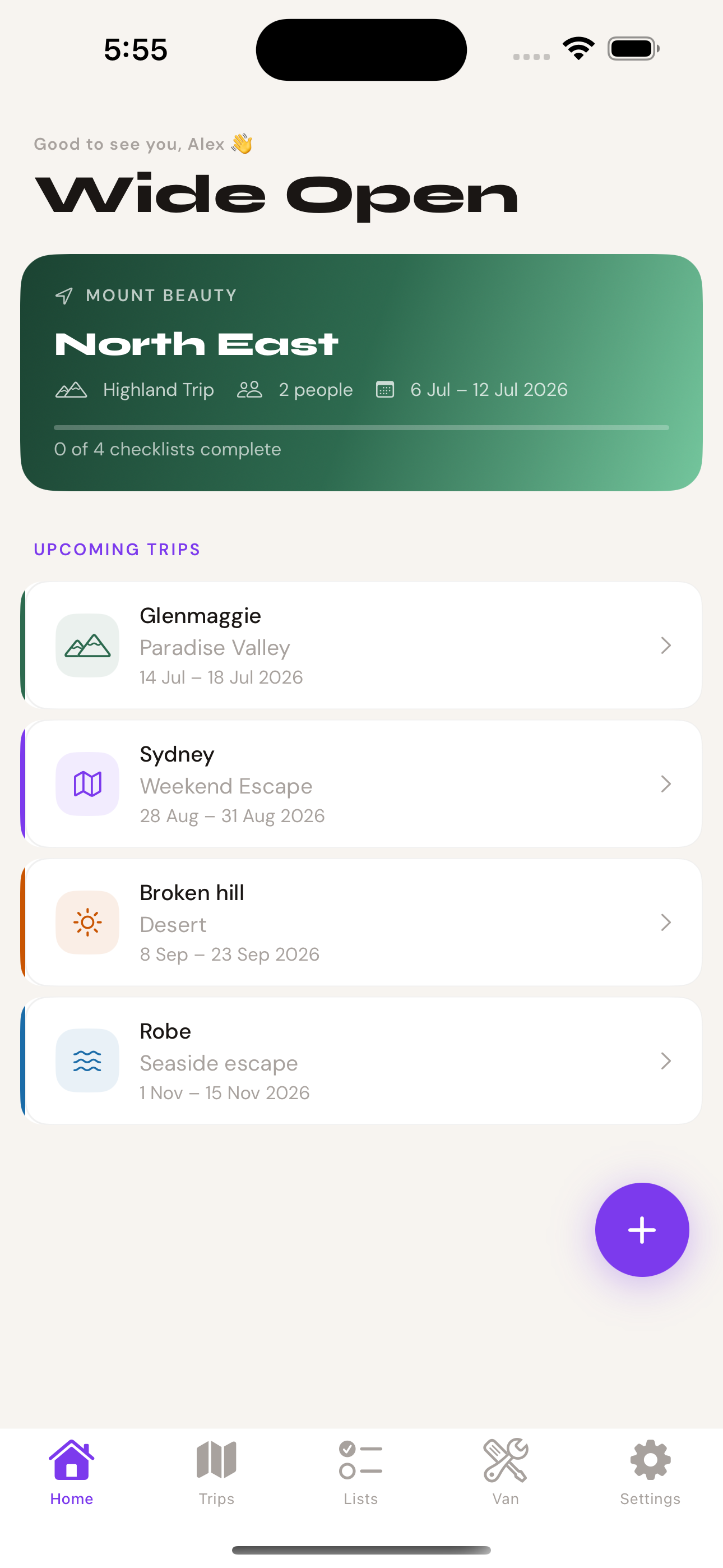
Create and manage multiple trips at once. Set destinations, travel dates, crew size, and pick your landscape theme. All your adventures in one place.
Never leave the driveway without the safety chains crossed again. 16-point checklists cover everything from hitch coupling to tyre pressures — and you can add your own custom items.
Track service status for every component — wheel bearings, gas regulators, breakaway batteries. Get early warnings before something becomes a problem in the middle of nowhere.
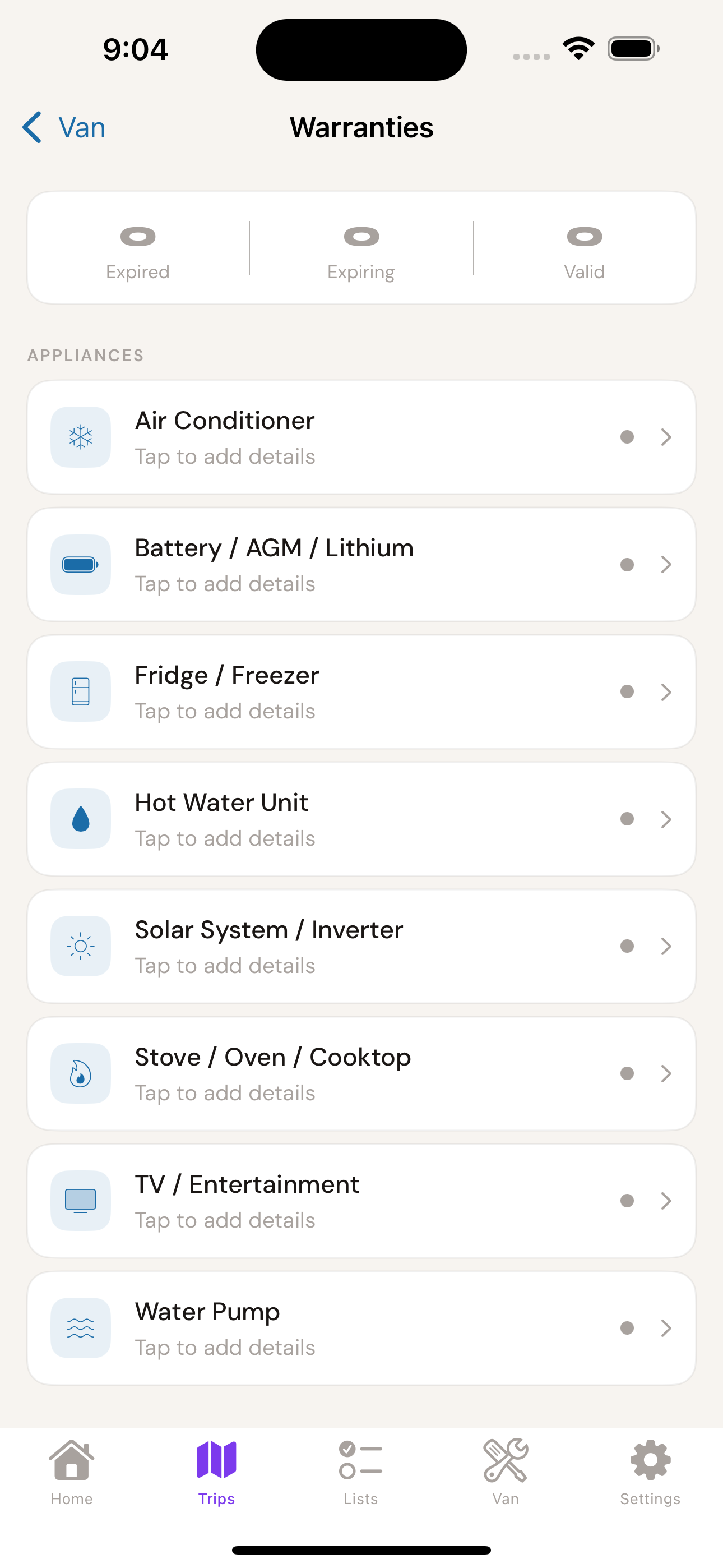
One place for all your appliance warranties. Know exactly when your Dometic fridge or Truma hot water expires — before it expires on the road.
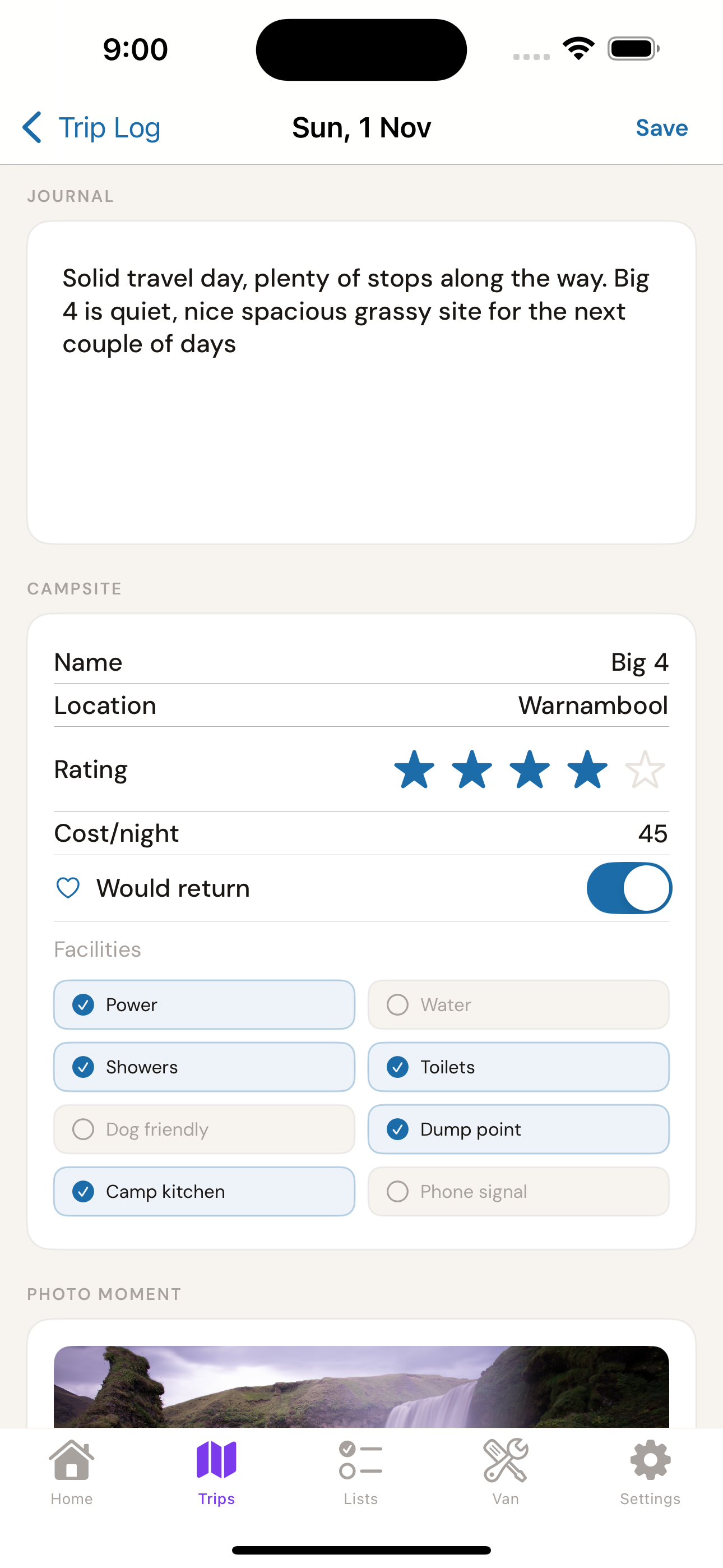
Daily journal, campsite ratings, facilities checklist, cost per night, and a photo moment — all attached to each day. Your personal record of every adventure, forever.
Rate every campsite, log facilities, cost per night, and flip the "Would return" toggle. Build a personal campsite guide you actually trust — not one written by someone who visited in 2019.
Day-by-day planning for each trip. Map out your stops, add notes about distances and bookings, and keep everything in one place so the whole crew is on the same page.
Per-trip shopping lists with categories and tick-off interface. Camp Kitchen feeds ingredients directly to your list — so your food shopping is half done before you add a single item manually.
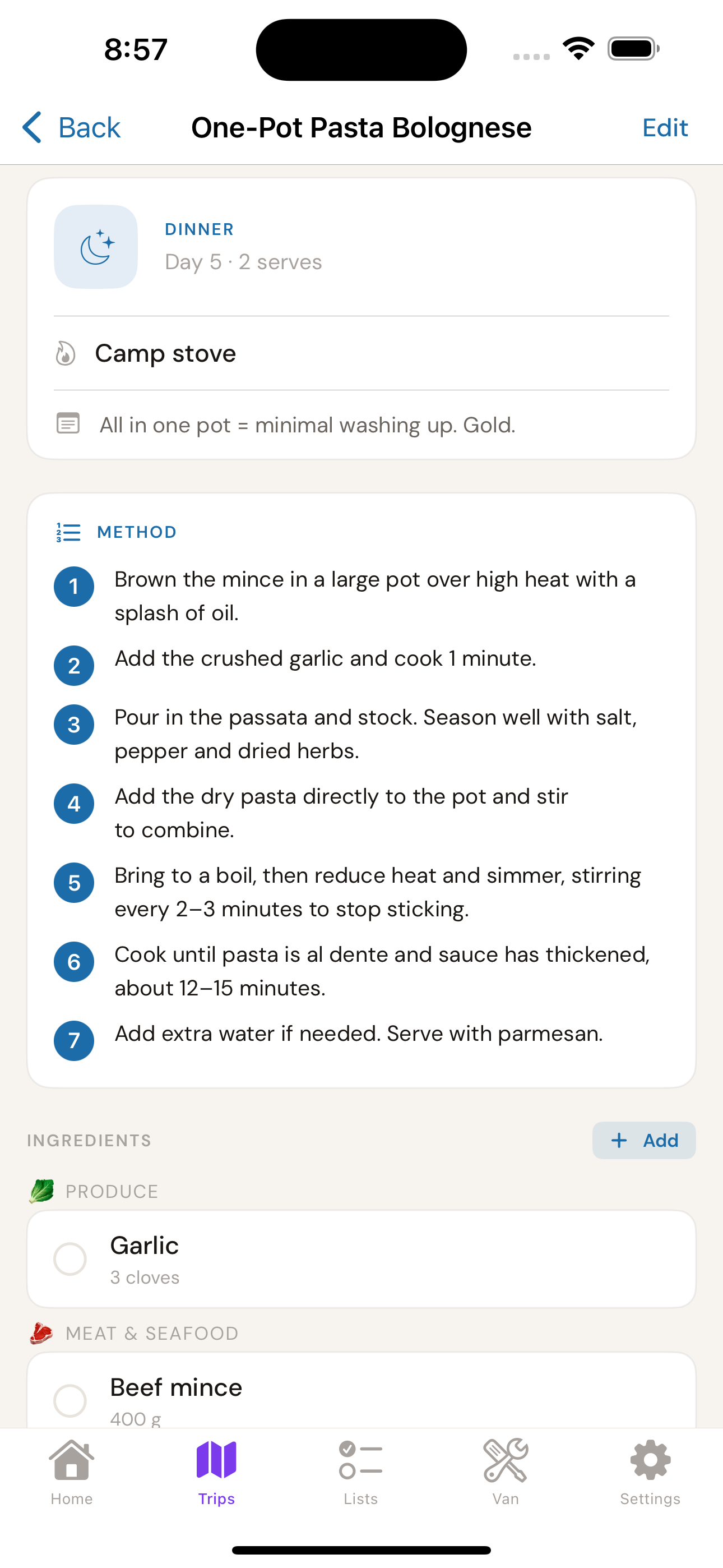
Meal planning and recipes built around your trip dates and crew size. Build a library of camp favourites, plan meals by day, and let the app scale quantities automatically.
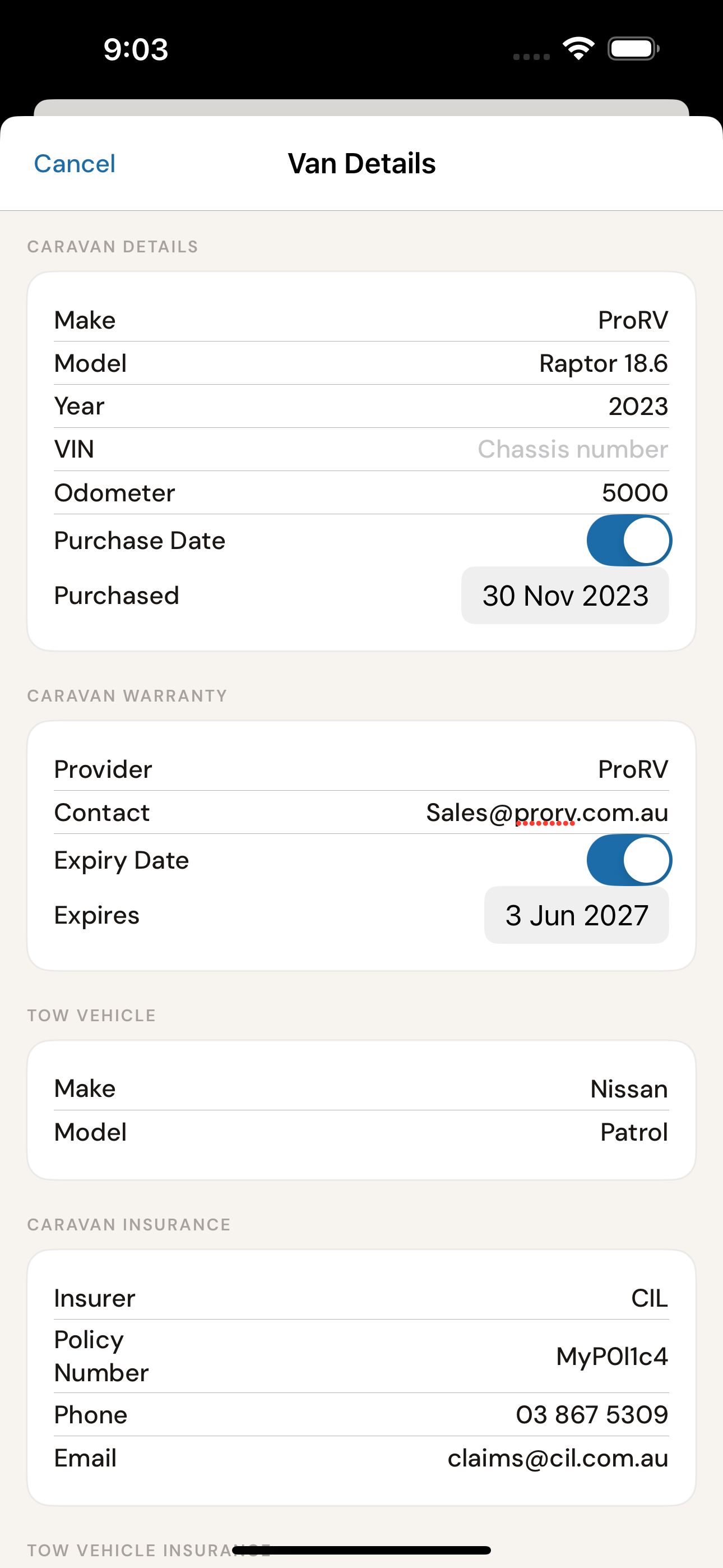
Store insurance policy details, roadside assist membership, and emergency contacts — all available offline. When something goes wrong 300km from anywhere, you'll want this to hand.
Wide Open Australia is the only caravan app that visually adapts to where you're going. Head outback and the app shifts to burnt orange and gold. Coast-bound? Deep navy to aqua. High country? Forest green. It's a small thing that makes every trip feel like its own adventure.
No signal? No worries. Everything you need works completely offline — perfect for remote outback tracks where connectivity is a distant memory.
Create a trip in under a minute. Wide Open Australia handles the structure — you handle the driving. Every trip gets its own landscape identity, progress tracking, and gear checklist.
A thorough pre-departure checklist is the difference between a smooth trip and a stressful one. We've built one based on real caravan safety protocols — covering every critical check before you hit the highway.
Caravans have a lot of moving parts. Literally. The maintenance tracker keeps an eye on service intervals for everything from wheel bearings to gas regulators — so you know about problems before they become roadside disasters.
Your complete caravan companion
Launch price AUD · One-time purchase · No subscription · No hidden fees
Everything you need to know, from your very first trip to power-user tips.
Set up your first trip in under a minute.
From the Home tab, tap the orange "Create New Trip" button. This opens the trip creation form. You can have as many trips active or saved as you like — there's no limit.
Name it something meaningful — "Broken Hill May 26", "Robe Easter", whatever works for you. Add the destination location (e.g. "Broken Hill, NSW") and your crew size. This info appears on your trip card and in your history.
Set your departure date. Wide Open Australia uses this to sort your trip list chronologically and will eventually use it to surface helpful reminders before you leave.
Select the landscape that best matches your destination — Outback, Coastal, High Country, or leave it on the default Dusk theme. This sets the gradient hero card colour for the entire trip. You can change it at any time.
Once created, you'll see the Trip Detail screen with your modules: Itinerary, Checklists, Camp Kitchen, Trip Log, and Maintenance. Your checklist progress percentage updates in real time on the hero card at the top. Aim for all checklists complete before you depart.

Your safety net before every single trip.
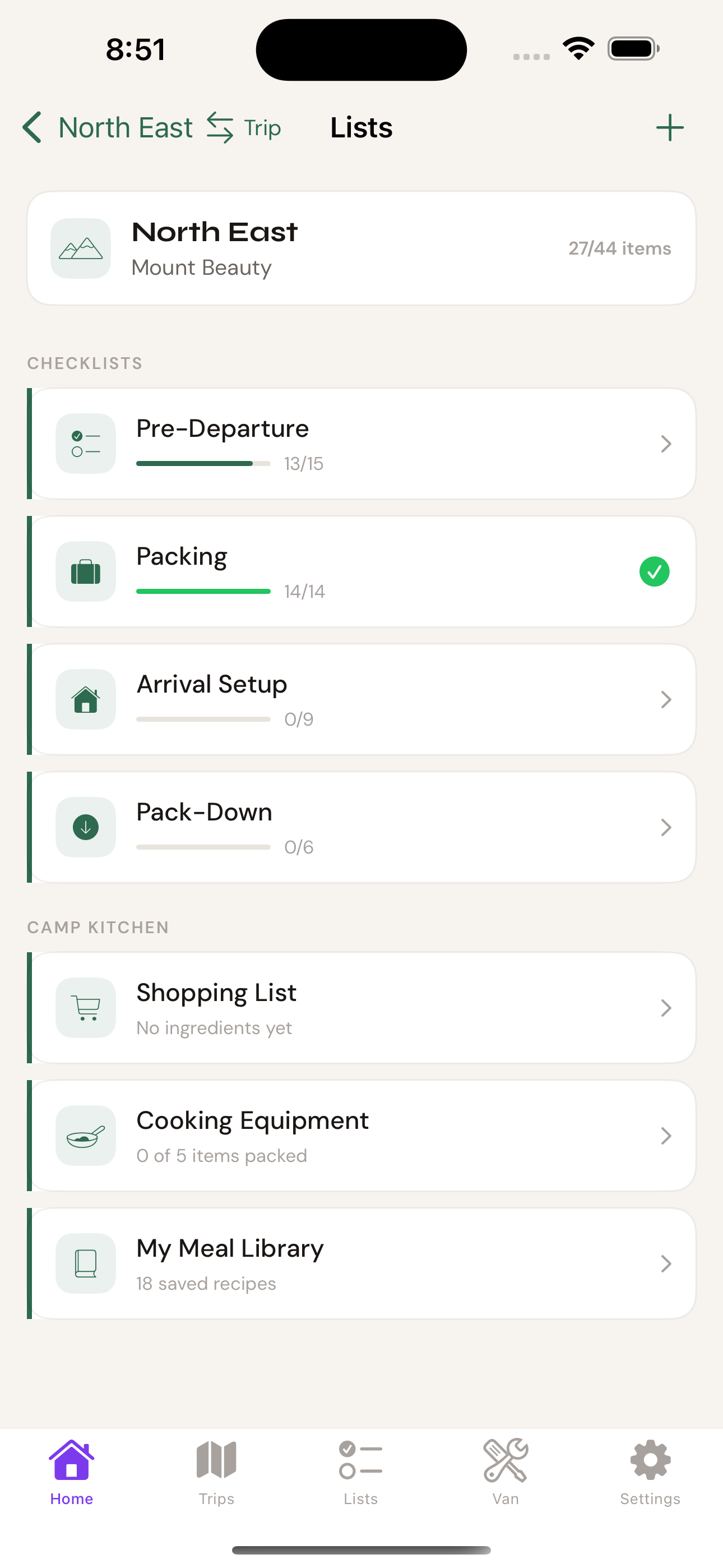
Tap the Checklists module from your trip. You'll see four checklists: Pre-Departure, Packing, Arrival Setup, and Pack-Down. Each has its own progress bar — your trip's overall checklist progress reflects all four combined. A green tick appears on a checklist card when it's 100% complete.
Each item has a minimum 52pt tap target (large and easy to hit, even with cold hands at 6am). Tap an item to mark it complete. It shows a checkmark and moves visually to indicate done. Tap again to uncheck if you made a mistake.
Every rig is different. Tap "+ Add custom item" at the bottom of the checklist to add items specific to your van setup — "solar panel angle set", "fridge switched to 12V", whatever your process requires. Custom items are saved and reused for future trips.
The Pre-Departure checklist shows as complete (green) on your Lists screen when all items are ticked. Make it a rule: don't pull out of the driveway until it's green.


Plan your days so you actually get to everything you want to see.
Tap the Itinerary module from inside your trip. You'll see a day-by-day view based on your trip dates. Each day is a card you can fill in with planned stops, activities, and drive times.
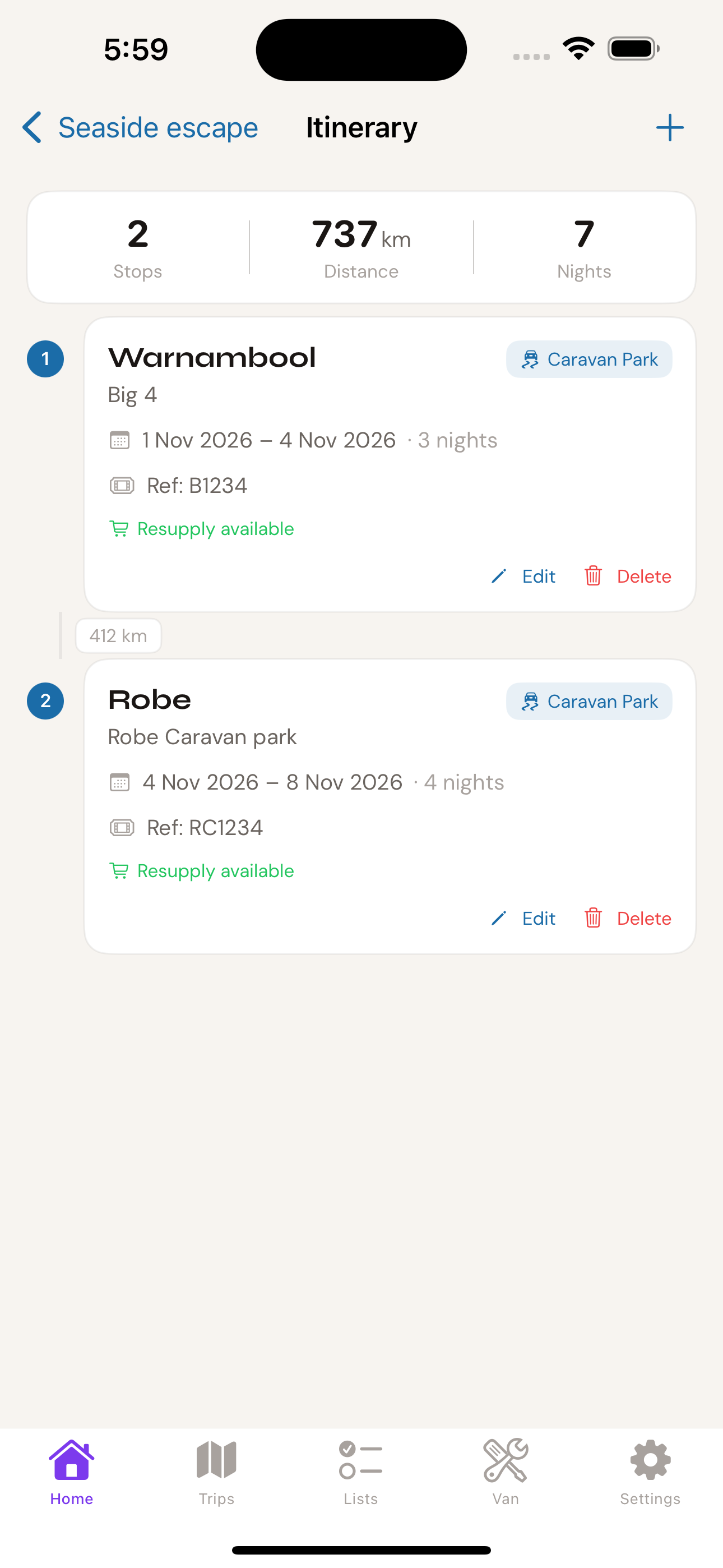
Tap the + button to add a stop. Enter the location name, caravan park name, arrival and departure dates (nights auto-calculate), and your booking reference number. The app shows total stops, total distance, and total nights at a glance in the summary strip at the top.
The itinerary shows the distance between consecutive stops (e.g. "412 km" between Warnambool and Robe). This helps you plan realistic driving days and spot legs that are too long for comfort — nobody wants a 600km tow day.
Add your caravan park booking reference directly to the stop card. No more hunting through emails at 5pm trying to find the confirmation number. It's right there, offline, on the stop you're arriving at.

Never arrive at camp missing something critical.
The Shopping List is per-trip — so each adventure has its own list. Open it from the Shopping List module in your trip. You'll see a clean list of items with categories and a tick-off interface for when you're actually in the shop.
Tap the + button to add items. You can enter item name, category (Food, Toiletries, Camping Gear, etc.), and optional quantity. Items are grouped by category so you can work through the supermarket section by section — the way a sensible person shops.
Start your shopping list the week before the trip, not the morning of. Add items as you think of them. Running low on gas mantles? Add it now. Need a new stubby holder? Extremely important — add it now.
When you're at the shops, tap each item to mark it collected. Ticked items drop to the bottom of their category so your remaining list stays clean and readable. When everything's ticked — you're good to go.

Meal planning and camp cooking, sorted.
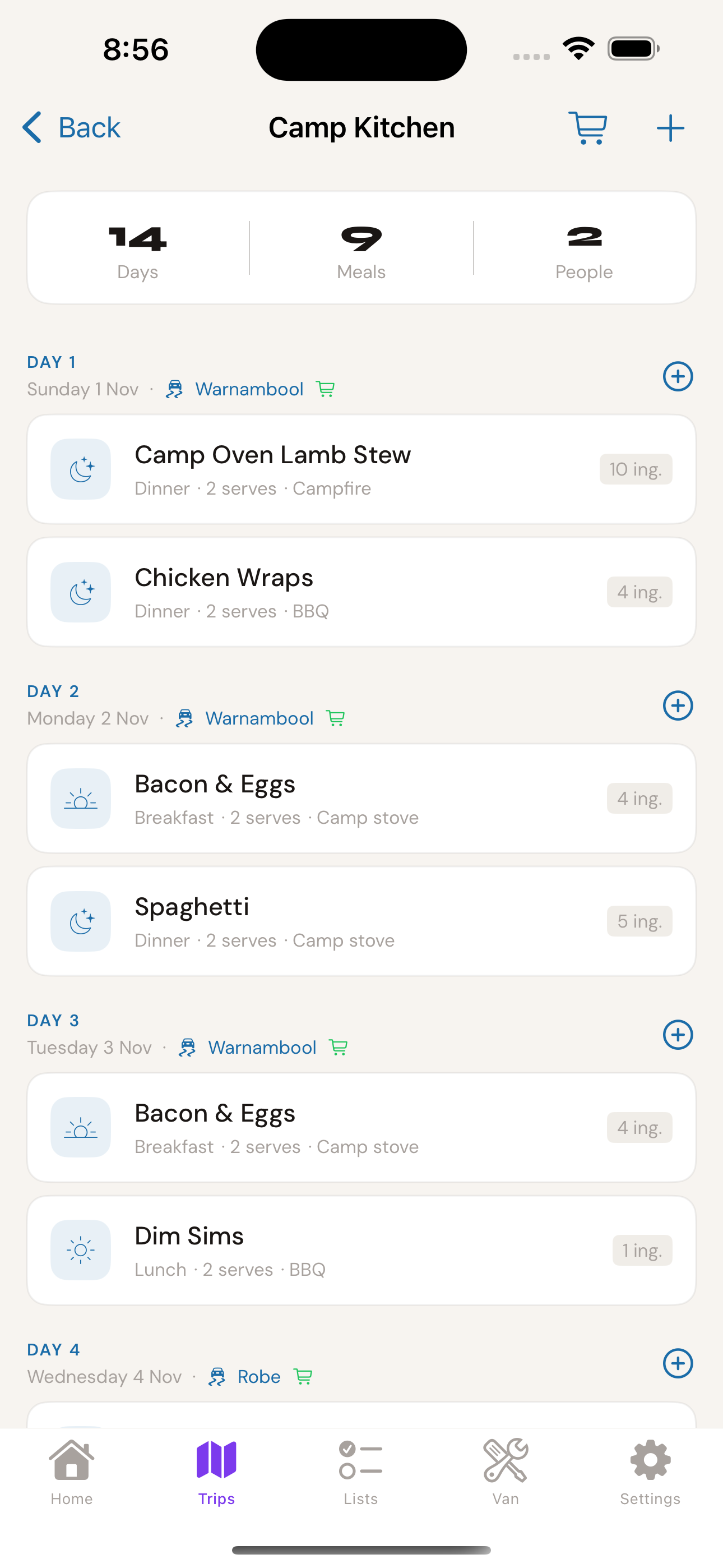
Tap the Camp Kitchen module inside your trip. You'll find your meal planner, recipe collection, and cooking notes all in one place — organised around your trip dates and crew size.
The meal planner shows your trip day by day, grouped by stop location. Tap any day to assign meals — breakfast, lunch, or dinner — from your recipe library. Wide Open Australia uses your crew size (set when you create the trip) to scale quantities automatically. So if you're feeding four, it calculates for four.
Build up a library of your go-to camp meals. Add recipe name, ingredients (with quantities), and method notes. Once saved, you can assign them to meal slots in any future trip — your campfire chilli is always one tap away.
Once you've planned your meals, Camp Kitchen can push the required ingredients directly to your trip's Shopping List. One tap and your food shopping is fully populated. It's a proper workflow — not a set of disconnected lists.


Journal, campsites, expenses — your record of every adventure.
Trip Log is the "during the trip" module. While you're on the road, tap in each day to capture your journal entry, campsite details, and a photo moment. Think of it as a lightweight travel diary that lives inside your trip record.
Each day has a journal field — a free-text space to capture how the day went. It doesn't have to be long. "Solid travel day, plenty of stops along the way. Big 4 is quiet, nice spacious grassy site for the next couple of days" is perfect. A sentence or two while it's fresh beats trying to remember it three weeks later.
For each stop, record the campsite name, location, your star rating, cost per night, and whether you'd return. Then tick off available facilities — Power, Water, Showers, Toilets, Dump Point, Dog Friendly, Camp Kitchen, Phone Signal. Over time this becomes a personal campsite guide you actually trust.
Add a photo to the day's log — the view from the campsite, the campfire, whatever sums up the day. It becomes the visual memory attached to that entry. When you scroll back through old trips, the photo is the thing that brings it all back.

Know what needs attention before it needs attention.
The Van tab in the bottom navigation gives you a persistent view of your van's health regardless of which trip you're on. You can also access it from any Trip Detail screen under the Maintenance module row.
The default items cover the most common caravan service points: wheel bearings, gas regulator, tyre age, breakaway battery, and water pump. Tap any item to set its last-serviced date and service interval. Wide Open Australia calculates the next due date and tracks the countdown.
Each service item shows one of three statuses: Good ✓ (well within interval), Due Soon ⚠️ (coming up in the next 30–60 days), or Overdue ! (past service date). The Van Health summary on your trip screen shows counts at a glance.
When you get a service done, tap the item, tap "Log Service", and enter today's date. The countdown resets from that date. Over time you build a service history — useful for resale value and warranty claims.

Stop losing warranty cards in the glovebox.
The Warranty Register lives inside the Van section. You'll see a list of your registered appliances and their warranty status — Active, Expiring Soon, or Expired.
Tap the + button to add an appliance. Enter the name (e.g. "Dometic Fridge"), purchase date, and warranty period (usually found on your warranty card or in the manual). Wide Open Australia calculates the expiry date and remaining time automatically.
Items showing "Exp in X days" are approaching their expiry. Use this window to check the appliance thoroughly — if something needs a warranty claim, do it before the clock runs out. An "Expired" status means the manufacturer's warranty has passed.

Everything you need in an emergency — in your pocket, offline.
Insurance, Roadside Assist, and Emergency Contacts are all stored in the Van section. They're not trip-specific — they live at the van level so they're always accessible regardless of which trip is active. In an emergency, you don't want to be hunting through a trip screen to find your insurer's number.
Enter your caravan and vehicle insurer names, policy numbers, and emergency claim phone numbers. Add the policy renewal date so you get a heads-up before it lapses — the last thing you want is to discover you're uninsured at a roadside stop.
Add your roadside assistance provider details — NRMA, RAA, RAC, RACQ, RACV, or whoever you're with. Store the membership number and the 24-hour call-out number. If you're heading remote, also note any specific coverage limits (not all standard plans cover outback tracks).
Store the key people who should be contacted if something goes wrong. This is separate from your phone's contacts — it's specifically curated for emergency situations and visible in the app quickly. Add each person's name, relationship, and phone number.
All of this information is stored locally on your device. In an emergency in a remote area with no signal, everything here is still fully accessible. That's by design — the time to discover your insurer's number isn't loading is not when you're on the side of the Stuart Highway at midnight.

Make your app feel like the trip you're on.
Each trip has its own landscape theme. The theme sets the gradient hero card, progress bar colour, active tab icon, module icon accents, and trip row border. When you switch between trips, the app visually shifts to match.
☀️ Outback / Desert — burnt orange to gold. Use for anything inland: Simpson Desert, Broken Hill, Flinders Ranges, Coober Pedy, Nullarbor.
🌊 Coastal / Beach — deep navy to aqua. Use for beach trips: Robe, Great Ocean Road, Ningaloo Reef, Sunshine Coast.
⛰️ High Country — forest green to sage. Use for mountains and rainforests: Snowy Mountains, Alpine NP, Daintree.
🌆 Dusk — purple to amber. The default theme. The Australian sky at 6pm.
Open the trip, tap the edit icon, and change the landscape selection. The entire UI updates instantly. It's purely visual — no data is affected.
Get more out of Wide Open Australia.
Spend 10 minutes after downloading setting up your Van profile completely — make, model, year, and all service items with their current intervals. Everything flows from this. The maintenance tracker is only as useful as the data you put in.
Don't create the trip the night before. Create it a week out so you can work through the checklist and maintenance module at a relaxed pace. Rushed pre-departure checks are how things get missed.
Every rig has its own quirks. Spend your first trip noting down the things that aren't on the standard checklist and add them as custom items. They'll be there for every future trip.
Rate your trips when you get home, while it's fresh. Three months later you'll genuinely appreciate having a record of which campsite was a 5-star and which one you'd skip next time.
Don't wait until something goes wrong to wish you'd logged it. When a new appliance arrives, open Wide Open Australia and add it to the warranty register immediately. It takes 30 seconds.